Board intake
01Read the schematic, vendor drop, boot logs and product constraints before changing the tree.
PMIC and railspanel and touchstorage and flashing
Platforms
We take silicon vendor BSPs, evaluation-kit assumptions and custom carrier-board changes, then turn them into booting, maintainable platform images for products that have to ship.
Boards we support
Mobile, industrial, media and automotive SoC families.
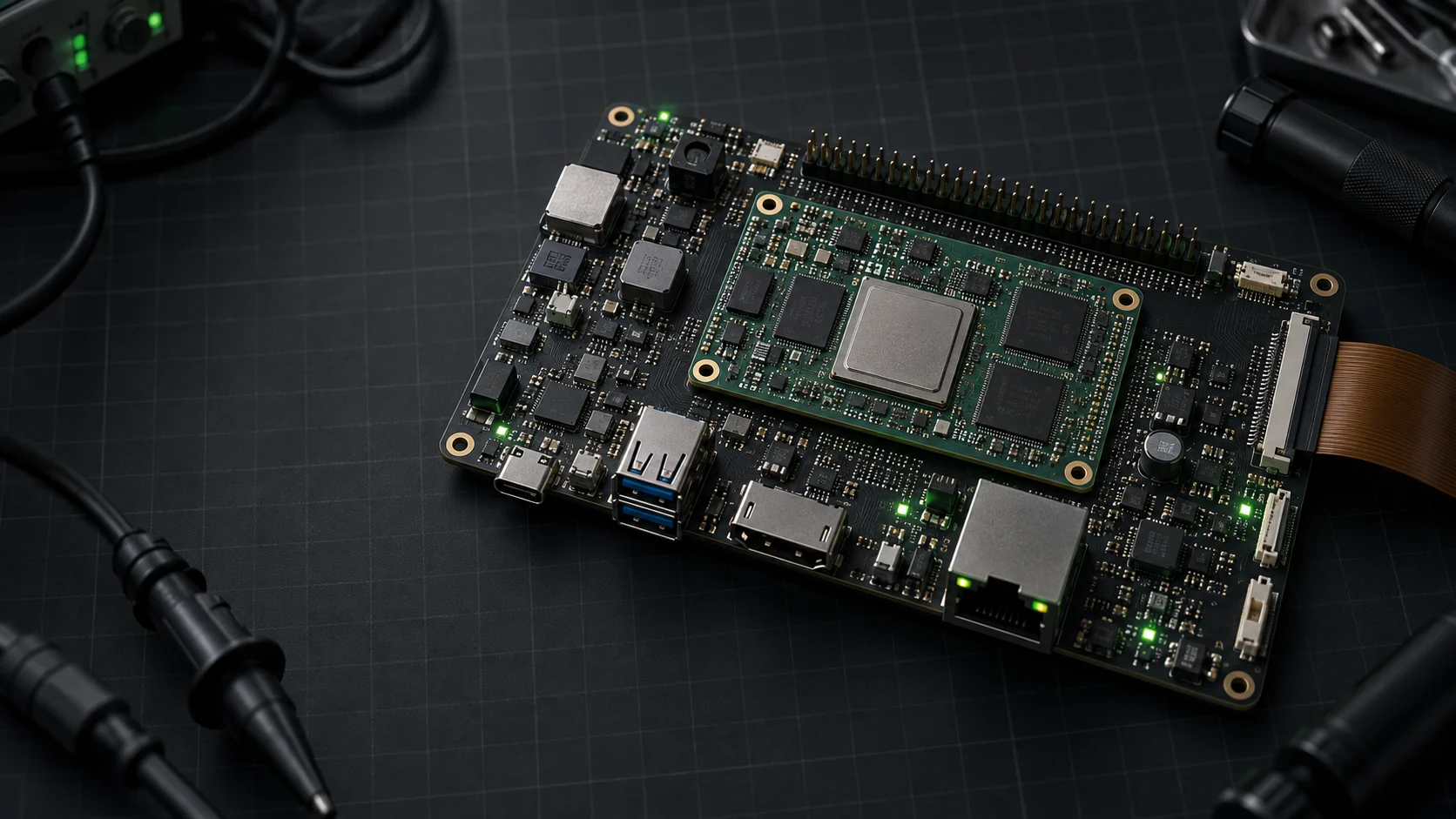
SoCs, modules, EVKs and single-board computers in our support map.
Android, embedded Linux and vendor BSPs carried into products.
Bring-up surface
Most schedule risk sits in the board-specific details: power sequencing, peripheral dependencies, vendor forks and the update path that has to survive future releases.
Read the schematic, vendor drop, boot logs and product constraints before changing the tree.
Get the SoC from mask ROM to a repeatable boot path that matches the product security model.
Move the reference board files onto your carrier and stabilize the peripherals that make the device real.
Turn the bring-up into something your product team can flash, test, update and keep shipping.
The exact stack changes by vendor, but the failure points tend to rhyme. We keep the board support work connected to the product image instead of treating each layer as a separate handoff.
Board map
The current support map covers 10 board families and 87+ named SoCs, modules and development kits. Custom carrier boards are expected, not an exception.
Our most requested family. Strong price-to-performance for signage, HMI and edge AI — and vendor trees rough enough that custom boards always need work.
Long-lifecycle industrial and medical work. Android and Yocto on the same module, plus NPU enablement on the 8M Plus.
Mobile-class performance for handhelds and automotive cockpits. Vendor BSP integration and CRD-to-custom-board porting.
Robotics and edge AI, where the GPU and camera pipeline are the product. Jetson Linux (L4T) rather than Android — we say so rather than overpromise.
Industrial control and automotive, often paired with real-time cores. Linux is the norm; Android is viable on AM62-class parts.
Excellent for prototypes and low-volume products. Android runs via community AOSP ports rather than official support, so GMS certification is not available — worth knowing before you design it in.
Cortex-A7 plus Cortex-M4 for deterministic control. OpenSTLinux and Yocto — Android is not a realistic fit on this class of part, and we will tell you that up front.
Android TV and set-top boxes, including Google TV requirements and operator launcher variants.
Cost-sensitive consumer and industrial devices where BOM cost drives the design.
Genio platform bring-up and MediaTek BSP customisation for non-reference hardware.
Silicon vendors
Each vendor has its own release cadence, kernel fork and set of sharp edges. Familiarity with those details saves months when the reference design stops matching your hardware.
Snapdragon mobile, QCS / QCM IoT, SA automotive, etc.
Vendor BSP integration, CRD-to-custom-board porting, and the Qualcomm release cadence.
Genio IoT, Dimensity, MT8xxx, etc.
Genio platform bring-up and MediaTek BSP customisation for non-reference hardware.
i.MX 8, i.MX 8M Plus, i.MX 93 / 95, etc.
Android and Yocto on i.MX, including the vendor kernel and NPU enablement.
RK3588 / RK3576 / RK3568, etc.
Popular for signage, HMI and edge AI. Strong price-to-performance, rough vendor trees.
AM62, AM62A, Sitara, Jacinto, etc.
Industrial and automotive targets, frequently paired with real-time cores.
S9xx series, etc.
Android TV and set-top box platforms, including Google TV requirements.
R-Car series, etc.
Automotive cockpit and gateway programmes with functional safety expectations.
Jetson Orin, Tegra, etc.
Edge AI and robotics targets where the GPU stack is the point.
Exynos, etc.
Mobile and wearable platforms on the Exynos vendor stack.
A-series, T-series, etc.
Cost-sensitive consumer and industrial devices.
x86 Android, Celadon, etc.
x86 Android targets for kiosk, retail and virtualised deployments.
Connectivity and STB SoCs, etc.
Wi-Fi and Bluetooth module integration across many of the platforms above.
Working on something not listed? The bring-up process is the same — ask us.
Device classes
The stack changes shape depending on what the device has to do. These are the categories we see most.
IVI head units, instrument clusters, rear-seat entertainment and telematics gateways, where boot deadlines and vehicle bus integration drive the architecture.
Rugged handhelds, HMIs and instrument controllers that need long support windows, deterministic behaviour and a documented security posture.
Point-of-sale terminals, payment devices and self-service kiosks where the platform must be locked down and certifiable.
Set-top boxes, streaming devices, tablets and smart displays, typically with GMS or Google TV certification in scope.
Platforms where camera pipelines, accelerators and real-time control matter more than the application framework.
Gateways and headless devices, often on embedded Linux rather than Android, with fleet update requirements from day one.
Reality check
Vendor BSPs are written for the vendor's evaluation kit. The moment your schematic diverges — a different PMIC, a new panel, a relocated bus — the reference tree stops being correct. Closing that gap is the work.
Vendor kernels carry out-of-tree patches, stale forks and code that never expected your peripheral set. We keep what is useful, rebase what is not, and document what we carried and why.
Whether a board can take the next Android release is decided during bring-up, in how cleanly the vendor interface is separated. We build for the upgrade you have not scheduled yet.